Oak Bay
Why there’s a Chinese cemetery at Harling Point
The site was chosen in 1903 by feng shui, meant as a stopover before burial in China. A war on the other side of the Pacific changed that, and 849 people stayed.
A resting place that was never meant to be permanent
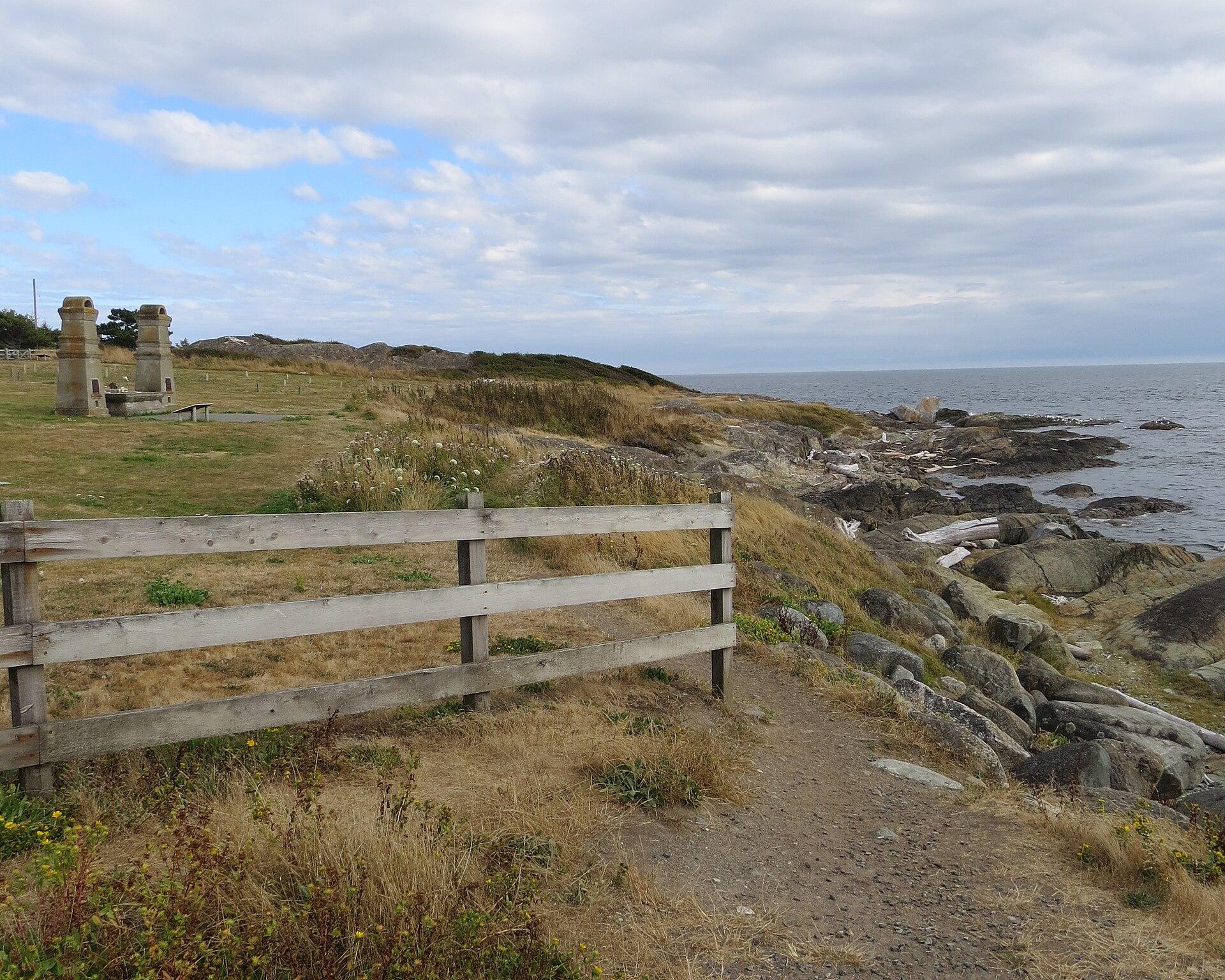
Walk the shoreline path at the foot of Penzance Street and you reach a 3.5 acre field sloping toward the Strait of Juan de Fuca. There are no trees, no straight lanes, no ornamental shrubs. Just grass, 300 headstones, two stone towers, an altar, and 13 memorial stones marking mass graves.
This is the Chinese Cemetery at Harling Point. For much of its history it was not a cemetery at all in the way most people think of one. It was a stopover.
The Chinese Consolidated Benevolent Association bought the land in 1903, according to the District of Oak Bay. Traditionally, the association said, the site was "a sanctuary of temporary repose before final interment in China, a pattern which reflected the early aspirations of these immigrants to return to their homeland."
The plan was that bodies would rest here, then be sent home.
Why the graves stayed
That plan broke in 1937. When the Sino-Japanese war broke out, Parks Canada notes, it was no longer possible to ship remains back to China.
The backlog grew. In November 1961, the bones of 849 Chinese pioneers, gathered from across Canada, whose return to China had been blocked since 1937, were finally laid to rest at Harling Point. The 13 memorial stones in the field mark those mass burials.
The cemetery had remained in active use for private burials until 1950. It was formally closed in 1961 with that mass interment. From then on it became a memorial site honouring Chinese-Canadian pioneers, Parks Canada said.
A landscape built on feng shui
The reason the site looks the way it does is deliberate. The association chose Harling Point in 1903 for how its elements fit together, following feng shui, a practice meant to attain a harmonious balance with the natural environment and, Parks Canada says, harmony in the afterlife.
The details follow the principle. The burial area faces southwest, sheltered from unfavourable winds from the north, east and west by natural promontories. The views of the strait and the Olympic Mountains are left unobstructed. The altar and the twin incinerator towers sit at the centre, oriented southwest like most of the grave rows.
There are no straight lines. The passageway curves, because feng shui holds that roadways should never point directly at gravesites. The absence of trees and shrubbery is intentional too.
Parks Canada calls it the largest concentration of pre-1950 Chinese mortuary features in Canada. The federal government designated it a National Historic Site in 1994.
The people who settled before 1923
The 849 pioneers belong to a larger story. Many Chinese men who came to Canada in that era arrived as sojourners, intending to return home, shaped by pre-revolutionary Chinese culture.
The pattern was not unique to Oak Bay. In April 2026 the Cowichan Valley Regional District formally recognized Hillcrest Cemetery near Duncan, where 127 Chinese Canadians are buried, as a heritage site, the Times Colonist reported. Most of those buried there came from six counties in Guangdong province to work in the lumber industry.
Wendy Jang, whose father worked at the Hillcrest mill, described the same situation that stranded the Harling Point dead. "It was a place of rest for the Chinese who came here, many who lived as bachelors, passed away and could not be sent home," she told the Times Colonist. Immigration policies, the Chinese head tax and the 1923 Chinese Exclusion Act, kept many men from bringing their families.
How to visit
The cemetery sits at Crescent Road and Penzance Street in Oak Bay. The Chinese Consolidated Benevolent Association still owns and maintains it.
The history packed into this one shoreline has drawn attention beyond the historians. Sarah Mcleod, a recently retired teacher-librarian at Glenlyon Norfolk Junior School, built her "heritage hikes" partly around Harling Point. The idea came to her while walking there, struck by how much history sat in one small area, from geological history to Indigenous creation stories to the Chinese cemetery. She won a 2026 Governor General's History Award for the work, to be presented in Victoria this week.
"The lightbulb went off," she told the Times Colonist, recalling the thought that followed: "We have to bring the kids here."